1
/
of
1
田辺三菱製薬株式会社
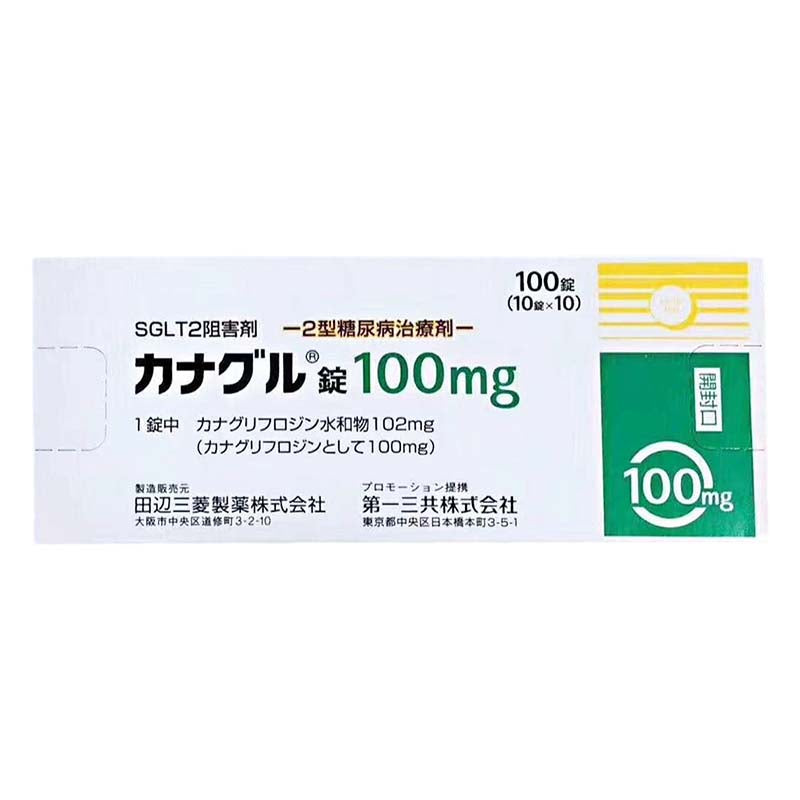
Canagliflozin 100mg 100 tablets CANAGLU Tablets Mitsubishi Tanabe SGLT2 Type 2 Diabetes
Canagliflozin 100mg 100 tablets CANAGLU Tablets Mitsubishi Tanabe SGLT2 Type 2 Diabetes
Regular price
¥23,000 JPY
Regular price
Sale price
¥23,000 JPY
Unit price
/
per
Taxes included.
Couldn't load pickup availability
Canagliflozin is commonly used to treat type 2 diabetes.
I. Basic Drug Information
- Generic Name : Canagliflozin Hydrate Tablets; Canagliflozin Hydrate Orally Disintegrating Tablets
- English name : Canagliflozin Hydrate Tablets; Canagliflozin Hydrate Orally Disintegrating Tablets
- Product Name : Canal Tablets 100mg; Canal OD Tablets 100mg (カナグル锭100mg; カナグルOD 锭100mg)
-
Dosage form :
- Canarium tablets 100mg: pale yellow film-coated tablets
- Canarium OD tablets 100mg: Pale yellow-brown pigment tablets (orally disintegrating tablets)
-
Indications :
- Type 2 diabetes
- Chronic kidney disease with type 2 diabetes (excluding patients with end-stage renal disease or those undergoing dialysis).
-
Element :
- Canaru tablets 100mg : Each tablet contains 102mg of the active ingredient canagliflozin hydrate (equivalent to 100mg of canagliflozin); additives include D-mannitol, hydroxypropyl cellulose, croscarmellose sodium, sodium stearoyl fumarate, talc, polyvinyl alcohol (partial saponification), polyethylene glycol 4000, titanium dioxide, yellow ferric oxide, and ferric oxide.
- Canaru OD Tablets 100mg : Each tablet contains 102mg of the active ingredient canagliflozin hydrate (equivalent to 100mg of canagliflozin); additives include D-mannitol, hydroxypropyl cellulose, low-substituted hydroxypropyl cellulose, polyvinyl alcohol (fully saponified), croscarmellose sodium, sodium stearoyl fumarate, sucralose, yellow ferric oxide, flavoring, and tocopherol.
-
Characteristics :
- Canaruru tablets 100mg : 7.6mm in diameter, 3.4mm in thickness, 144.3mg in weight, are pale yellow film-coated tablets.
- Canaroo OD tablets 100mg : 9.5mm in diameter, 4.4mm in thickness, 303mg in weight, are light yellowish-brown pigment tablets (orally disintegrating tablets).
II. Usage and Dosage
Normally, the adult dose is 100 mg of canagliflozin once daily, taken orally before or after breakfast.
III. Taboos
- Patients with a history of allergy to any of the ingredients in this medicine.
- Patients with severe ketoacidosis, diabetic coma, or pre-coma (who require rapid correction of hyperglycemia via intravenous fluids and insulin and are not suitable for this medication) should not use this medication.
- Patients with severe infections, before and after surgery, or with severe trauma (it is recommended to control blood sugar through insulin injections; this medication is not suitable for them).
IV. Precautions
-
Special populations :
- Patients with comorbidities/previous medical history: There is limited experience with patients with heart failure (NYHA functional class IV), and the safety has not been established; caution should be exercised in patients at high risk of hypoglycemia (such as pituitary insufficiency, adrenal insufficiency, malnutrition, etc.); patients at high risk of dehydration (such as the elderly, patients with renal impairment, and patients using diuretics) may experience increased dehydration due to the diuretic effect.
- Patients with renal impairment: Patients with severe renal impairment or end-stage renal disease on dialysis (the blood glucose-lowering effect is not significant in the treatment of type 2 diabetes, and it is not recommended to use it); patients with moderate renal impairment (the blood glucose-lowering effect may be insufficient, and the necessity should be carefully assessed).
- Patients with liver dysfunction: Clinical trials have not been conducted for patients with severe liver dysfunction (Child-Pugh score > 9), so caution is advised.
- Pregnant women and women who may be pregnant: Not recommended for use. It is recommended to use insulin preparations instead (animal experiments show that the drug can cross the placenta and may affect the fetus).
- Breastfeeding women: It is recommended to stop breastfeeding (animal studies have shown that the drug can enter breast milk and may affect offspring).
- Children: No clinical trials have been conducted in children, and safety has not been established.
- Elderly individuals: Their physiological functions often decline, which may delay their perception of dehydration symptoms (such as thirst), requiring close monitoring.
-
Medication instructions :
- Patients should be fully informed of the symptoms of hypoglycemia and how to manage it. Those engaged in activities such as working at heights or driving should be aware of the risk of hypoglycemia.
- This medication may cause polyuria, urinary frequency, and fluid depletion, so patients should be advised to replenish fluids appropriately; in particular, attention should be paid to the fact that dehydration may lead to serious conditions such as thromboembolism and ketoacidosis.
- It may cause urinary tract infections and genital infections, and in severe cases, it can lead to pyelonephritis, necrotizing fasciitis, sepsis, etc. Patients should be informed of the relevant symptoms and the importance of seeking medical attention in a timely manner.
- Blood glucose needs to be monitored regularly during medication. If the effect is not good after 3 months, a change of treatment plan should be considered. At the same time, kidney function should be monitored regularly. If eGFR is consistently lower than 45 mL/min/1.73 m², medication should be discontinued.
- Orally disintegrating tablets (OD tablets) disintegrate on the tongue with saliva and can be taken with or without water; however, they should not be taken without water while in bed.
-
Drug storage : Store at room temperature; shelf life is 3 years.
V. Adverse Reactions
- Allergic reactions : Rash, urticaria, eczema, etc. may occur (incidence <1%). Close observation is required. If any abnormality occurs, discontinue the medication and take appropriate measures.
-
Digestive system reaction :
- Common cause: constipation (incidence ≥1%).
- Less common: abdominal distension, abdominal pain, diarrhea, dry mouth, gastritis, nausea, vomiting, etc. (incidence rate 0.1%~1%).
VI. Drug Interactions
| Drug category/name | Interactions and Processing | mechanism |
|---|---|---|
| Diabetes medications (such as sulfonylureas, insulin, etc.) | It may increase the risk of hypoglycemia, and dosage reduction should be considered when using sulfonylureas or insulin in combination. | Enhanced blood sugar lowering effect |
| Drugs that enhance the hypoglycemic effect (such as beta-blockers and salicylates) | Blood glucose and patient condition need to be closely monitored. | Enhanced blood sugar lowering effect |
| Drugs that weaken the blood sugar lowering effect (such as adrenaline and glucocorticoids) | Blood glucose and the patient's condition need to be closely monitored. | The effect of lowering blood sugar is weakened. |
| Digoxin | Combined use may increase digoxin blood concentration, and appropriate observation is required. | This drug inhibits P-glycoprotein, thus affecting digoxin excretion. |
| Rifampin, phenytoin, etc. | Combined use may reduce the blood concentration of this drug, and appropriate observation is required. | Induces the metabolism of this drug by its metabolic enzymes (UGT1A9, UGT2B4), thus accelerating the metabolism of this drug. |
| Diuretics (such as furosemide, thiazides) | It may enhance the diuretic effect, and the dosage of diuretics should be adjusted according to the situation. | Superimposed diuretic effect |
| lithium carbonate | This may weaken the effect of lithium. | May reduce serum lithium concentration |
VII. Pharmacological effects
- Modulating biomembrane function : By inhibiting sodium-glucose cotransporter 2 (SGLT2) in the proximal convoluted tubule of the kidney, glucose reabsorption is reduced, urinary glucose excretion is increased, and blood glucose is lowered.
- Improves metabolic disorders : Promotes urinary glucose excretion, improves glucose metabolism, and reduces HbA1c and postprandial blood glucose; it may also improve related metabolic disorders by reducing sodium reabsorption.
- Regulating blood lipids : There is no explicit mention of a direct effect on regulating blood lipids; it mainly affects metabolic indicators indirectly by improving glucose metabolism.
- Protects blood vessels : Reduces renal glucose reabsorption, lowers intraglomerular pressure, and inhibits increased urinary protein excretion; long-term use may exert a kidney-protective effect by inhibiting inflammation and reducing renal tubular hypoxia stress.
VIII. Pharmacokinetics
-
absorb :
- The absolute bioavailability is approximately 65%. After a single oral dose of 100 mg, the time to peak concentration (tmax) is approximately 1-2 hours, and the peak plasma concentration (Cmax) is approximately 1126 ng/mL.
- Eating has little effect on absorption, but may prolong tmax by about 1 hour.
- Orally disintegrating tablets are bioequivalent to regular tablets, and absorption is not affected whether they are taken with or without water.
-
excretion :
- It is mainly excreted through feces (60.4%) and urine (32.5%), with feces mainly containing the original form and urine mainly containing metabolites.
- The half-life (t1/2) is about 10 to 12 hours, and this drug is difficult to remove from patients with end-stage renal disease through dialysis.
IX. Clinical Research
- Monotherapy for type 2 diabetes : In patients with type 2 diabetes whose diet and exercise control is poor, after 24 weeks of treatment with 100 mg daily, HbA1c decreased by 0.74% from baseline, fasting blood glucose decreased by 31.6 mg/dL, and body weight decreased by 3.76%.
- When used in combination with other hypoglycemic agents : After 52 weeks of combined use with sulfonylureas, DPP-4 inhibitors, etc., HbA1c can be reduced by 0.76% to 1.06%, but the incidence of hypoglycemia is slightly increased (16.1% when used in combination with sulfonylureas).
- Type 2 diabetes with chronic kidney disease : In patients with eGFR of 30–90 mL/min/1.73 m², treatment with 100 mg daily for approximately 115 weeks reduced the combined risk of renal function deterioration and cardiovascular death (hazard ratio 0.70).
10. Packaging Specifications
- Canaruru tablets 100mg: 100 tablets (10 tablets x 10 blisters), 500 tablets (10 tablets x 50 blisters), 140 tablets (14 tablets x 10 blisters), 500 tablets (bulk).
- Canaroo OD tablets 100mg: 100 tablets (10 tablets x 10 blisters).
XI. Production Information
- Manufacturer : Mitsubishi Tanabe Pharma Corporation
Share