1
/
of
1
高田製薬株式会社
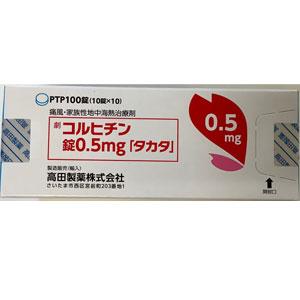
Colchicine tablets 0.5mg 100 tablets COLCHICINE Tablets “TAKATA” Colchicine
Colchicine tablets 0.5mg 100 tablets COLCHICINE Tablets “TAKATA” Colchicine
Regular price
¥2,000 JPY
Regular price
Sale price
¥2,000 JPY
Unit price
/
per
Taxes included.
Couldn't load pickup availability
Colchicine is an alkaloid drug that exerts its anti-inflammatory and analgesic effects mainly by inhibiting leukocyte chemotaxis, adhesion and phagocytosis, as well as reducing the release of inflammatory mediators. It is particularly effective for acute attacks of gouty arthritis.
I. Basic Drug Information
- Generic name : Colchicine tablets
- English Name : COLCHICINE Tablets “TAKATA”
- Product name : Kohl's tablets, Takata tablets
- Dosage form : Plain tablets
-
Indications
- Relief and prevention of gout attacks
- Familial Mediterranean fever
-
Element
active ingredients add value 1 tablet of コルヒチン0.5mg Lactose water mixture, トウモロコシデンプン, バレイショデンプン, タルク, ステアリンマグネシウム, Cyan No. 1 -
Properties
Properties shape Recognize コード Surface diameter It's heavy inside Thick sides Cyan 円shaped の素甭である. About 7.0mm Approximately 0.11g Approximately 2.1mm TTS-592
II. Usage and Dosage
-
Relief and prevention of gout attacks
- Normally, the adult dosage is 3-4 mg of colchicine, divided into 6-8 oral doses. The dosage may be adjusted according to age and symptoms.
- For prevention of the disease, adults usually take 0.5 to 1 mg of colchicine per day. If there is a premonition of an attack, take 0.5 mg orally once.
- The earlier you start taking medication after a gout attack, the more effective it will be.
- For the treatment of gout attacks, administer 0.5 mg once and continue until the pain subsides, every 3-4 hours. As the dosage increases, the incidence of gastrointestinal disturbances such as diarrhea increases; therefore, the daily dose is best kept below 1.8 mg.
- If you feel warning signs 3 to 4 hours before an attack, you should take the medication as soon as possible.
- Long-term preventative use of gout medication may cause serious side effects such as blood disorders, genital disorders, liver and kidney dysfunction, and hair loss, with little benefit, and is therefore not recommended.
-
Familial Mediterranean fever
- Normally, the adult dose of colchicine is 0.5 mg daily, divided into one or two oral doses. The dosage may be adjusted according to the patient's condition, but the maximum daily dose is 1.5 mg.
- Normally, the dosage for children is 0.01–0.02 mg/kg of colchicine per day, divided into one or two oral doses. The dosage may be adjusted according to the patient's condition, but the maximum daily dose is 0.03 mg/kg and should not exceed the maximum daily dose for adults.
III. Taboos
- Patients with a history of allergy to any of the ingredients in this product.
- Patients with liver or kidney disorders, or those taking medications that strongly inhibit the liver metabolic enzyme CYP3A4 or P-glycoprotein.
- Relief and prevention of gout attacks: pregnant women or women who may become pregnant.
IV. Precautions
-
Special populations
- Patients who are significantly debilitated (especially those with kidney disease, gastrointestinal disease, or heart disease): may experience a worsening of their kidney disease, gastrointestinal disease, or heart disease.
- Patients with renal impairment: Patients with renal impairment who are not taking the concomitant medications described in 9.2.1 should start with a very low dose. Plasma concentrations of this agent may be elevated, and serious side effects may occur early on.
- Patients with hepatic impairment: Patients with hepatic impairment who are not taking the concomitant medications described in 9.3.1 should start with a very low dose. Plasma concentrations of this agent may be elevated, and serious side effects may occur early on.
- Pregnancy: Relief and prevention of gout attacks: This medication is contraindicated in pregnant women or women who may become pregnant. In a single intraperitoneal administration study in mice, dose-dependent teratogenicity (meningioma, microphthalmia, anophthalmia, etc.) was observed starting from the lowest dose equivalent to 4.9 mg (equivalent to a 60 kg human dose). Familial Mediterranean fever: This medication should only be administered to pregnant women or women who may become pregnant if the treatment benefits outweigh the risks. Although there are no reports of definite teratogenicity in pregnant women with familial Mediterranean fever who take this medication during pregnancy, human experience is limited.
- Breastfeeding mothers: Consider the treatment benefits and the nutritional benefits of breast milk, and investigate whether to continue or discontinue breastfeeding.
- Pediatrics, etc.: Relief and prevention of gout attacks: No clinical trials have been conducted in children, etc. Familial Mediterranean fever: There are no reports of this agent being used in children under 2 years of age.
- Elderly patients: Attention should be paid to dosage and dosing intervals, and the patient's condition should be closely monitored. Pharmacokinetic studies in elderly patients have shown a tendency for persistently high blood drug concentrations.
-
Medication guidance
- Patients should be instructed to remove the medication from the PTP blister pack before taking it. Reports indicate that if a PTP blister pack is accidentally ingested, its sharp, pointed ends may pierce the esophageal mucosa, causing perforation and serious complications such as mediastinitis.
- Due to excessive use or misuse, acute poisoning symptoms may occur within hours after taking the medication. Therefore, the dosage and administration instructions should be strictly followed, and relevant precautions should be taken.
-
Drug Preservation
- Store at room temperature.
- Once the outer box is opened, it should be stored in a light-proof environment.
- Validity period: 5 years.
V. Adverse Reactions
- Allergic reactions : Not explicitly mentioned.
-
Digestive system reaction
- Diarrhea, nausea, vomiting, abdominal pain, abdominal cramps.
-
Other adverse reactions
- Blood: Aplastic anemia, decreased granulocytes and globulins, decreased leukocytes, decreased platelet count (frequency unknown).
- Kidneys: Elevated BUN, elevated creatinine, positive urine protein, hematuria, oliguria (frequency unknown).
- Liver: Abnormal liver function (elevated AST, elevated ALT, elevated γ-GTP), elevated Al-P (frequency unknown).
- Muscles: Rhabdomyolysis, myopathy (frequency unknown). Rhabdomyolysis is characterized by muscle pain, weakness, elevated CK, and elevated myoglobin in the blood and urine, and may be accompanied by serious kidney damage such as acute kidney injury. Myopathy may be accompanied by muscle pain, muscle weakness, and elevated CK.
- Nerve: Peripheral nerve disorder (frequency unknown).
- Other symptoms: fatigue, hair loss (frequency unknown).
VI. Drug Interactions
This agent is primarily metabolized by the liver metabolic enzyme CYP3A4 and is also a substrate of P-glycoprotein.
| Drug name, metabolic enzymes | P-glycoprotein | Clinical symptoms and treatment methods | Mechanism, risk factors |
|---|---|---|---|
| inhibitors | The effects of this medication may be enhanced. When used concurrently with other medications, dosage should be reduced or started at a lower dose. Furthermore, this medication is contraindicated in patients with liver or kidney dysfunction. | Inhibiting the activity of P-glycoprotein may increase the blood concentration of this agent. |
VII. Pharmacological effects
- Moderating biomembrane function : Not explicitly mentioned.
- Improvement of metabolic abnormalities : Not explicitly mentioned.
- Regulating blood lipids : Not explicitly mentioned.
- Protecting blood vessels : Not explicitly mentioned.
-
Other functions
- Colchicine binds to tubulin, causing the contraction (disaggregation) and disappearance of fibrous microtubules in granulocytes (mainly neutrophils) and other motile cells, inhibiting granulocyte migration to the inflammatory area, and reducing granulocyte metabolic and phagocytic activity. As a result, it inhibits the release of lactic acid and pro-inflammatory enzymes induced by uric acid crystal phagocytosis, thereby suppressing the inflammatory response.
- Colchicine inhibits the release of histamine-containing granules from mast cells.
- Colchicine has the effect of inhibiting cell mitosis, but this effect is not related to the inhibition of gout attacks, and the anti-tumor effect based on this effect is considered to be weak.
VIII. Pharmacokinetics
- Absorption : Bioavailability (mean ± SD): 37 ± 12%.
-
excretion
- Location: in bile and urine.
- Total clearance (1 mg single oral dose, foreign data): patients with normal renal function: 0.726 L/hr/kg; patients with renal impairment: 0.168 L/hr/kg.
-
blood concentration
- In healthy adults (foreign data): after a single oral dose of 1 mg, Cmax (ng/mL) was 5.64±1.37, Tmax (hr) was 1.01±0.56, and AUC0-48 (ng・hr/mL) was 47.9±12.2.
- Elderly individuals: In 6 healthy adult males and 4 elderly females, the serum concentrations (mean±SD) after a single oral dose of 1 mg were 5.5±1.4 ng/mL and 12±4 ng/mL, respectively. The concentrations were higher in the elderly, and the time to peak concentration tended to be longer in the elderly.
- Patients with renal impairment: In 4 patients with normal renal function and 4 patients with renal impairment (3 patients on hemodialysis and 1 patient with creatinine clearance of 15 mL/min), the plasma concentration half-life (mean ± SD) after a single oral dose of 1 mg was 4.4 ± 1.0 hr and 18.8 ± 1.2 hr, respectively.
- Patients with liver disorders: In 8 patients with liver disorders, when administered a single oral dose of 1 mg, the Cmax (mean ± SD) was 3.60 ± 1.04 ng/mL and the Tmax (mean ± SD) was 2.16 ± 0.34 hr.
- Distribution : Volume of distribution (Vd/F) 4.87 L/kg (1 mg single oral dose, foreign data).
- Metabolism : After absorption from the digestive tract, a portion undergoes deacetylation in the liver. The majority of the unchanged products and metabolites undergo enterohepatic circulation.
-
Pharmacokinetics in patients with specific backgrounds
- Administration to pregnant women: It can cross the placenta and can also be detected in the umbilical cord blood of newborns.
- Administration to lactating mothers: The concentration of colchicine in the breast milk of 4 patients with familial Mediterranean fever who took 1–1.5 mg of colchicine daily ranged from 1.9 to 8.6 ng/mL, similar to the variation in plasma concentration. Assuming an average breast milk intake of 150 mL/kg for infants, the estimated daily colchicine intake for infants is 1.29 μg/kg (approximately 10% of that in adults).
- Administration to patients with renal insufficiency: This medication cannot be removed by hemodialysis.
- Duration of action : 3-4 hours.
IX. Clinical Research
- In overseas clinical trials comparing the efficacy of low-dose (1.8 mg/day) and high-dose (4.8 mg/day) colchicine in controlling pain attacks, the results showed no difference between the two groups. Furthermore, the high-dose group had a higher incidence of gastrointestinal adverse events such as diarrhea.
- There are reports that when the father takes this medication, his spouse may give birth to a child with Down syndrome or other congenital abnormalities.
10. Packaging Specifications
100 tablets [10 tablets (PTP)×10]
XI. Production Information
Manufacturer : Takata Pharmaceutical Co., Ltd.
Share