1
/
of
1
アステラス製薬株式会社
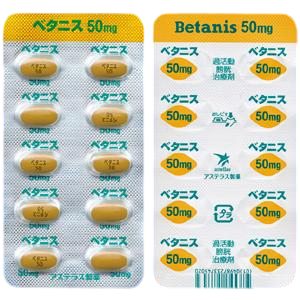
Betanis Mirabellon Tablets 50mg 100 tablets (Astella for urinary urgency, frequency, and incontinence)
Betanis Mirabellon Tablets 50mg 100 tablets (Astella for urinary urgency, frequency, and incontinence)
Regular price
¥36,500 JPY
Regular price
Sale price
¥36,500 JPY
Unit price
/
per
Taxes included.
Couldn't load pickup availability
Betanis Mirabell tablets improve urinary urgency, frequency, and incontinence caused by overactive bladder by relaxing bladder smooth muscle and increasing bladder capacity.
I. Basic Drug Information
- Common name : Mirabelon
- English name : Mirabegron
- Product Name : Beta Nis Tablets
- Dosage form : Tablets (film-coated tablets)
- Indications : Urgency, frequency, and urge incontinence caused by overactive bladder.
-
Element :
- Active ingredient (per tablet): Mirabegron 25mg or 50mg
- Additives: ポリエチレンオキサイド, マクロゴール, ヒドロキシプロピルセルロース, ジブチルヒドロキシトルエン, ステアリンマグネシウム, ヒプロメロース, yellow iron tridiolate, iron tridiolate, etc.
-
Characteristics :
- 25mg: Brown film-coated tablet, approximately 12.1mm in long diameter, 6.1mm in short diameter, 5.2mm thick, and weighing approximately 0.258g.
- 50mg: Yellow film-coated tablet, approximately 12.1mm long diameter, 6.1mm short diameter, 5.2mm thick, and weighing approximately 0.258g.
II. Usage and Dosage
- Usual dosage : Adults usually take 50 mg once daily after meals.
-
Adjustments for special population groups :
- For patients with moderate hepatic impairment (Child-Pugh score 7-9): once daily, starting with 25 mg.
- For patients with severe renal impairment (eGFR 15~29 mL/min/1.73 m²): once daily, starting with 25 mg.
III. Taboos
- Patients with a history of allergy to any of the ingredients in this product.
- Patients with severe heart disease (may exacerbate symptoms such as increased heart rate).
- Pregnant women and women who may become pregnant (animal studies have shown that it can affect the fetus).
- Breastfeeding women (the medication can enter breast milk and affect the infant).
- Patients with severe hepatic impairment (Child-Pugh score of 10 or above may have excessively high blood drug concentrations).
- Patients currently taking flecainide acetate or propafenone hydrochloride (may cause QT prolongation and ventricular arrhythmias).
IV. Precautions
-
Special populations :
- Patients with cardiovascular disease: An electrocardiogram (ECG) should be performed before taking the medication to be alert for QT prolongation or arrhythmia.
- Patients with hepatic or renal dysfunction: Blood drug concentrations may be elevated in patients with mild to moderate hepatic or renal dysfunction, requiring close monitoring.
- People of reproductive age: Avoid using it as much as possible (animal experiments show that it affects reproductive organs).
- Elderly patients: Liver and kidney function may decline, so caution should be exercised when administering medication and observation is necessary.
- Children: No domestic clinical studies have been conducted, and the safety and efficacy have not been confirmed.
-
Medication instructions :
- Avoid using it in combination with anticholinergic drugs, as it may cause urinary retention.
- Avoid using in combination with 5α-reductase inhibitors (safety not confirmed).
- Blood pressure should be monitored regularly during medication use (it may rise).
- It must be removed from the PTP packaging before consumption to avoid accidental swallowing of the packaging, which could cause esophageal damage.
- This is a sustained-release formulation and should not be split, crushed, or ground; it must be swallowed whole.
- Drug storage : Store at room temperature. After opening the PTP packaging, it must be protected from moisture. Bottled drugs must be tightly sealed (containing desiccant).
V. Adverse Reactions
- Allergic reactions : rash, urticaria, pruritus (incidence < 1%).
-
Digestive system reaction :
- 1%~5%: Constipation, dry mouth
- <1%: Abdominal discomfort, bloating, diarrhea, duodenitis, gastritis, stomatitis
- Frequency unknown: nausea, vomiting, abdominal pain, upper and lower abdominal pain
-
Other reactions :
- Cardiovascular: palpitations, tachycardia, elevated blood pressure (including systolic blood pressure ≥180 mmHg or diastolic blood pressure ≥110 mmHg), atrial fibrillation (frequency unknown).
- General symptoms: fatigue, edema, thirst (<1%), chest discomfort, chest pain (frequency unknown).
- Liver and gallbladder: Elevated levels of AST, ALT, γ-GTP, and Al-P (1%~5%)
- Neurological symptoms: headache, dizziness (<1%), tremor, sensory dullness, drowsiness (frequency unknown).
VI. Drug Interactions
| category | Drug Name | Clinical symptoms and treatment methods | Mechanisms and risk factors |
|---|---|---|---|
| Contraindications | Flucarbide acetate, propafenone hydrochloride | It may cause QT prolongation and ventricular arrhythmias (including torsades de pointes), and should be avoided when using it in combination. | Both have proarrhythmic effects; this agent inhibits CYP2D6, which may increase the plasma concentration of the other drug. |
| Notes on appropriate use | Captopril, adrenaline, etc. | May increase the risk of tachycardia and ventricular fibrillation. | Combined use to enhance adrenergic nerve stimulation |
| Notes on appropriate use | itraconazole, ritonavir, etc. | This may lead to an increase in the blood concentration of this drug, causing an increase in heart rate. | These drugs strongly inhibit CYP3A4 or P-glycoprotein, affecting the metabolism/transport of this agent. |
| Notes on appropriate use | Rifampin, phenytoin, etc. | May reduce the efficacy of this drug | These drugs induce CYP3A4 or P-glycoprotein, accelerating the metabolism/excretion of this agent. |
| Notes on appropriate use | Tricyclic antidepressants, fluoxetine, etc. | It may enhance the effect of the other party (such as an overly strong antidepressant). | This agent inhibits CYP2D6, increasing the plasma concentration of the drug. |
| Notes on appropriate use | Digoxin | Digoxin blood concentration needs to be monitored | This agent inhibits P-glycoprotein, which may increase digoxin blood concentration. |
VII. Pharmacological effects
- Moderating biomembrane function : No clear description.
- Improvement of metabolic abnormalities : No clear description.
- Regulating blood lipids : No clear description.
- Protecting blood vessels : No clear description.
- Core function : Stimulates β₃adrenergic receptors in bladder smooth muscle, promotes an increase in intracellular cAMP concentration, relaxes bladder smooth muscle, enhances urine storage function, and improves the urge to urinate, urinary frequency, and urinary incontinence caused by overactive bladder.
VIII. Pharmacokinetics
-
absorb :
- Absolute bioavailability: 25mg: 28.9%, 50mg: 35.4%, 100mg: 45.0% (foreign data).
- Absorption is better on an empty stomach than after a meal (the Cmax of 50 mg on an empty stomach is 2.11 times that after a meal, and the AUC is 1.47 times).
- Peak time (Tmax): approximately 3 to 4 hours.
-
excretion :
- Within 72 hours after administration, 55% was excreted in the urine and 34% in the feces; 45% of the drug in the urine was the unmetabolized parent drug.
- Half-life (t₁/₂): approximately 25 to 36 hours.
IX. Clinical Research
- Phase II double-blind trial : Patients with hyperactive bladders were given 25 mg, 50 mg, 100 mg of this drug or placebo for 12 weeks. The results showed that the number of urinations and the number of urinary incontinences in each dose group were significantly improved compared with placebo (P<0.001), and the incidence of side effects was 23.3% to 26.0% (18.9% for placebo).
- Phase III double-blind trial : The 50mg dose group showed a significant reduction in urination frequency, urgency, and incontinence compared to the placebo group (P<0.05), with an incidence of 24.5% (24.0% in placebo).
- Long-term dosing trials : 50 mg maintenance or 100 mg increments were administered for 52 weeks, with stable efficacy and an incidence of side effects of 30.0%–33.6%.
10. Packaging Specifications
- 25mg: 100 tablets/box (10 tablets x 10 blisters, including desiccant).
- 50mg: 100 tablets/box (10 tablets x 10 blisters, including desiccant); 500 tablets/box (10 tablets x 50 blisters or bottled, including desiccant).
XI. Production Information
Manufacturer : Astellas Pharmaceutical Co., Ltd.
Share