1
/
of
1
杏林製薬株式会社
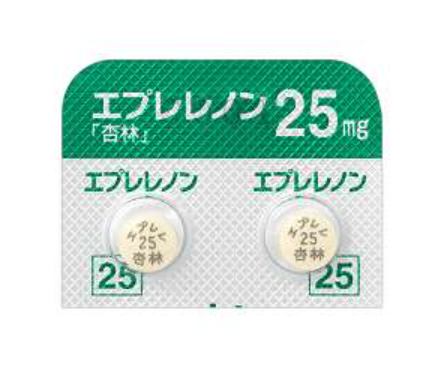
Eplerenone 25mg 100 tablets (for hypertension)
Eplerenone 25mg 100 tablets (for hypertension)
Regular price
¥3,300 JPY
Regular price
Sale price
¥3,300 JPY
Unit price
/
per
Couldn't load pickup availability
Eplerenone is an aldosterone receptor antagonist that reduces water and sodium retention, lowers blood pressure, and improves cardiac function by blocking the action of aldosterone. It is indicated for hypertension and heart failure after myocardial infarction.
I. Basic Drug Information
- Generic name : Eplerenone
- English name : EPLERENONE Tablets
- Product name : Euplerin tablets 25 mg, Xinglin, Eplerenone tablets 50mg, Xinglin, Eplerenone tablets 100mg, Xinglin (Eplerenone tablets 25mg) "Xinglin", 50mg "Xinglin", 100mg "Xinglin")
- Dosage form : Film-coated tablets
-
Indications :
- Hypertension;
- Chronic heart failure (used after basic treatment such as angiotensin-converting enzyme inhibitors, beta-blockers, and diuretics).
-
Element :
- Active ingredient: Each tablet contains 25mg, 50mg, or 100mg of eplerenone;
- Additives: lactose syrup, crystalline cellulose, croscarmellose sodium cellulose, hydroxypropyl methylcellulose, sodium lauryl sulfate, talc, magnesium stearate, titanium dioxide, polyethylene glycol 6000, ferric oxide, etc.
-
Characteristics :
- 25mg: Yellow film-coated tablets, 5.6mm in diameter and 3.3mm thick, labeled "Eprere 25 Kyourin";
- 50mg: Light red film-coated tablets, 7.1mm in diameter and 4.1mm thick, labeled "Eprele 50 Kōrin";
- 100mg: Red film-coated tablet, 9.6mm in diameter and 4.7mm thick, labeled "Eprere 100 Kōrin".
II. Usage and Dosage
-
Hypertension :
The starting dose for adults is 50 mg once daily, which can be increased to 100 mg once daily if the effect is insufficient. -
Chronic heart failure :
- The starting dose for adults is 25 mg once daily, which can be increased to 50 mg once daily after 4 weeks (adjustments may be made based on serum potassium levels and patient condition).
- For patients with moderate renal insufficiency (creatinine clearance 30~<50mL/min): the starting dose is 25mg every other day, and the maximum dose is 25mg daily.
-
Dosage adjustment principles :
Adjust according to serum potassium levels (see table below):Serum potassium level (mEq/L) Usage and dosage adjustment <5.0 50 mg/day maintenance; 25 mg/day can be increased to 50 mg/day; 25 mg every other day can be increased to 25 mg/day. 5.0~5.4 Maintain current dose 5.5~5.9 Reduce from 50mg/day to 25mg/day; reduce from 25mg/day to 25mg every other day; the 25mg every other day dose needs to be discontinued. ≥6.0 Interrupt immediately; after restoring to <5.0, restart with 25mg every other day.
III. Taboos
- Those allergic to any of the ingredients in this product;
- Patients with hyperkalemia (serum potassium > 5.0 mEq/L) or serum potassium > 5.0 mEq/L at the start of medication;
- Patients with severe renal insufficiency (creatinine clearance < 30 mL/min) or severe hepatic insufficiency (Child-Pugh C cirrhosis);
- Those currently using potassium-sparing diuretics (such as spironolactone), other mineralocorticoid receptor antagonists, potent CYP3A4 inhibitors (such as itraconazole), and potassium preparations (except for those used for radioactive iodine protection);
- Patients with hypertension and microalbuminuria/proteinuria, and patients with moderate to severe renal insufficiency (creatinine clearance < 50 mL/min).
IV. Precautions
1. Special populations
- Pregnant women : Use only when the benefit of treatment outweighs the risk (animal studies show that it can cross the placenta, is not teratogenic, but has increased absorption in rabbit embryos).
- During lactation : It is necessary to weigh the options of discontinuing the medication or stopping breastfeeding (rat experiments show that the drug enters milk, but human data is unclear).
- Pediatrics : Not permitted due to lack of clinical research.
- Elderly individuals : Frequent monitoring of serum potassium is necessary (as kidney function is often impaired, the risk of hyperkalemia is high) to avoid excessive blood pressure reduction that could trigger a stroke.
2. Medication Instructions
- Monitoring requirements : Serum potassium, liver function, and serum sodium should be monitored before medication, within 1 week after medication, 1 month after medication, and regularly. For hypertensive patients, the dosage should be reduced if serum potassium is > 5.5 mEq/L, and medication should be discontinued if it is > 6.0 mEq/L.
- Medication warning : May cause dizziness; avoid driving or working at heights; when used in combination with CYP3A4 inhibitors, the dose should not exceed 25 mg/day.
3. Drug Preservation
- Storage method: Store at room temperature;
- Validity period: 3 years.
V. Adverse Reactions
1. Allergic reaction
- Frequency unknown: angioedema, urticaria, rash, itching.
2. Digestive system reactions
- More than 1%: Nausea, indigestion;
- 0.5~1%: Diarrhea, abdominal pain, constipation;
- Below 0.5%: Vomiting, dry mouth, gastritis.
VI. Drug Interactions
| category | Examples of drugs | Interactions and Processing |
|---|---|---|
| Contraindications for combined use | Potassium-sparing diuretics (spironolactone), potent CYP3A4 inhibitors (itraconazole) | Increased risk of hyperkalemia or high blood drug concentration; contraindicated. |
| Use with caution | ACEI/ARB (captopril), intermediate-acting CYP3A4 inhibitor (clarithromycin) | Increased risk of hyperkalemia necessitates frequent monitoring of serum potassium; the latter requires limiting eplerenone dose to ≤25mg/day. |
| Use with caution | CYP3A4 inducer (rifampin), St. John's wort | It may reduce the efficacy; avoid using them together. |
VII. Pharmacological effects
- Modulating biological membrane function : selectively blocking the binding of aldosterone to mineralocorticoid receptors, inhibiting membrane transport functions related to sodium reabsorption.
- Improve metabolic abnormalities : Reduce uric acid and triglycerides in hypertensive patients and improve myocardial energy metabolism in patients with heart failure.
- Regulating blood lipids : It has no direct lipid-regulating effect, but indirectly improves vascular lipid deposition by lowering blood pressure.
- Protects blood vessels : Inhibits excessive activation of the RAAS system, reduces vascular remodeling, and lowers the risk of cardiovascular events in patients with chronic heart failure.
VIII. Pharmacokinetics
- Absorption : Oral bioavailability is 69%, with a peak time of 1.5 hours. High-fat diets have little impact on absorption.
- Excretion : 67% is excreted in urine, 32% in feces, 2.5% is excreted unchanged, and the half-life is about 4 to 6 hours.
IX. Clinical Research
- Hypertension : Domestic trials show that 50-100mg/day can reduce systolic/diastolic blood pressure by 6.8-9.7/5.1-6.9 mmHg, with an adverse reaction rate of 23.1%.
- Chronic heart failure : International trials show that when used in combination with standard treatment, it can reduce the risk of cardiovascular death/heart failure hospitalization by 37% (HR=0.63) and the incidence of hyperkalemia by 6.6%.
10. Packaging Specifications
- 25mg: 100 tablets/box (10 tablets x 10 blister packs, PTP packaging);
- 50mg: 100 tablets/box (10 tablets x 10 blisters), 300 tablets/bottle;
- 100mg: 100 tablets/box (10 tablets x 10 blisters).
XI. Production Information
Manufacturer : Kyorin Pharmaceutical Co., Ltd.
Share