1
/
of
1
参天製薬株式会社
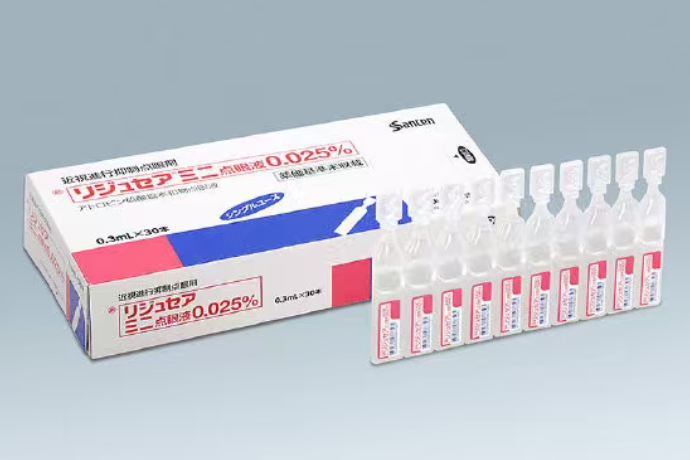
Atropine Sulfate Hydrate 0.025% 0.3mL x 30 drops (Santen Myopia Relief Eye Drops 0.025%)
Atropine Sulfate Hydrate 0.025% 0.3mL x 30 drops (Santen Myopia Relief Eye Drops 0.025%)
Regular price
¥8,000 JPY
Regular price
Sale price
¥8,000 JPY
Unit price
/
per
Couldn't load pickup availability
Atropine sulfate hydrate 0.025% is an anticholinergic eye drop that works by blocking cholinergic receptors in the eye, thus exerting mydriatic and accommodation-paralyzing effects. It is suitable for children's refractive examinations, cycloplegic refraction, and relieving ocular inflammation such as iridocyclitis.
I. Basic Drug Information
- Common name: Atropine sulfate hydrate
- English name: Atropine Sulfate Hydrate
- Product Name: RYJUSEA Mini Ophthalmic Solution 0.025%, Un Yasan 2 Ophthalmic Solution 0.025%
- Dosage form: eye drops
- Indications: Inhibition of myopia progression
- Element:
- Active ingredient: Each 1 mL contains 0.25 mg of atropine sulfate hydrate.
- Additives: concentrated glycerol, sodium dihydrogen phosphate hydrate, sodium citrate hydrate, hydroxyethyl cellulose, pH adjuster
- Characteristics:
- pH: 4.0~4.6
- Osmotic pressure ratio: 0.9~1.1
- Appearance: Colorless, clear, sterile aqueous eye drops
II. Usage and Dosage
Normally, one drop is taken once a day, before bedtime.
III. Taboos
- Patients with a history of allergy to any of the ingredients in this product.
- Patients with glaucoma and those with factors that cause increased intraocular pressure, such as narrow angle-closure glaucoma or shallow anterior chamber, may be at risk of acute angle-closure glaucoma attacks.
IV. Precautions
- Special populations:
- Breastfeeding women: The benefits of treatment and the nutritional benefits of breast milk should be considered together to weigh whether to continue or stop breastfeeding.
- Children, etc.: No clinical trials were conducted on low birth weight infants, newborns, infants, or children under 5 years old.
- Medication instructions:
- After applying eye drops, photophobia and blurred vision may occur due to pupil dilation. Before the symptoms subside, avoid using playground equipment that may cause a fall, riding a bicycle/car, or operating machinery. If necessary, wear sunglasses and avoid looking directly into sunlight or strong light.
- When using, the first 1-2 drops should be discarded and not instilled into the eye; when instilling the drops, be careful not to let the tip of the container directly touch the eye; after instilling the drops, open the eyelids and instill the solution into the conjunctival sac, close the eyes and press on the lacrimal sac for 1-5 minutes before opening the eyes again.
- When used in combination with other eye drops, an interval of at least 5 minutes is required.
- This product contains no preservatives and should be used only once after opening. Any remaining liquid should be discarded.
- Medication storage:
- Store at room temperature and keep away from light.
- After opening the aluminum-plastic packaging, it should be placed in the accompanying light-proof medicine bag, stored at room temperature, and used within 3 months.
V. Adverse Reactions
- Allergic reactions: Not explicitly mentioned.
- Digestive system reactions: Not explicitly mentioned.
- Other reactions:
- Eyes: More than 5% experience photophobia; 1% to 5% experience visual impairment, blurred vision, and pupillary obstruction; less than 1% experience accommodation disorder, eyelid eczema, and itchy eyes.
- Nervous system: 1%~5% experience headaches.
VI. Drug Interactions
When used in combination with drugs that have anticholinergic effects (such as tricyclic and tetracyclic antidepressants, phenothiazines, antihistamines, etc.), it may enhance systemic side effects such as those affecting the circulatory and nervous systems (due to the additive anticholinergic effects).
VII. Pharmacological effects
- Moderating biomembrane function: Not explicitly mentioned.
- Improvement of metabolic abnormalities: Not explicitly mentioned.
- Regulating blood lipids: Not explicitly mentioned.
- Protecting blood vessels: Not explicitly mentioned.
- Other uses:
- Mechanism of action: Atropine may participate in scleral remodeling directly or indirectly through muscarinic receptors in the retina or sclera, thereby inhibiting axial elongation.
- It has non-selective affinity for muscarinic receptors (M1, M2, M3, M4, M5 subtypes) (in vitro assay).
- Inhibition of myopia progression: The progression of experimental myopia can be inhibited by intravitreal administration to monkeys and by eye drops to guinea pigs, porcupines, and mice.
VIII. Pharmacokinetics
- Absorption: A study of 10 myopic patients aged 5-15 years, who used one drop once daily for 7 consecutive days, showed that on day 1, the peak plasma concentration (Cmax) was 19.7±7.0 pg/mL, the median time to peak concentration (tmax) was 60 minutes (range 5.0-60 minutes), and the area under the curve (AUC0-60min) was 939±370 pg・min/mL; on day 7, the Cmax was 16.5±3.6 pg/mL, the median tmax was 60 minutes (range 30-60 minutes), and the AUC0-60min was 798±188 pg・min/mL.
- Excretion: In healthy adult males, 88% of 14C-atropine 2 mg was excreted in the urine within 48 hours, of which about 50% was atropine unchanged and less than 2% was troponic acid; 14C was not detected in breath and only a small amount (less than 0.5% of the administered dose) was detected in feces.
- Distribution: After a single instillation of 2% 3H-atropine solution into both eyes of white guinea pigs, the highest concentration of 3H in the eye tissues was observed 1 hour later. The concentrations, from highest to lowest, were found in the cornea, sclera, iris ciliary body, aqueous humor, choroid, retina, and vitreous body. After a single instillation of 2% 3H-atropine solution into both eyes of colored and white guinea pigs, the concentration of 3H in the iris of colored guinea pigs was approximately 8 times that of white guinea pigs at 96 hours, suggesting that atropine may bind to melanin.
- Metabolism: Atropine can be N-demethylated to noratropine, oxidized to atropine-N-oxide, and hydrolyzed to tropine and tropine acid (based on foreign data).
IX. Clinical Research
Domestic Phase II/III trials: 299 myopic patients aged 5-15 years with an objective spherical equivalent power of -1.0D to -6.0D under accommodative paralysis and a progression of ≥0.5D in equivalent spherical power within one year were enrolled. They were given one drop of this drug, one 0.01% formulation, or pranoprofen eye drops once daily (before bedtime) for 36 months (24 months of Phase I treatment + 12 months of Phase II treatment). Results showed that after 24 months of treatment, the change in objective spherical equivalent power under accommodative paralysis was statistically significant compared to the pranoprofen eye drop group, confirming the superiority of this drug; the trend of change within 36 months of treatment was as expected. In the drug group (122 patients), 19 (15.6%) experienced side effects, mainly photophobia (9.0%).
10. Packaging Specifications
Plastic eye drop containers, 0.3mL x 30 drops (30 drops per aluminum-plastic bag).
XI. Production Information
Manufacturer: Santen Pharmaceutical Co., Ltd.
Share