1
/
of
1
アステラス製薬株式会社
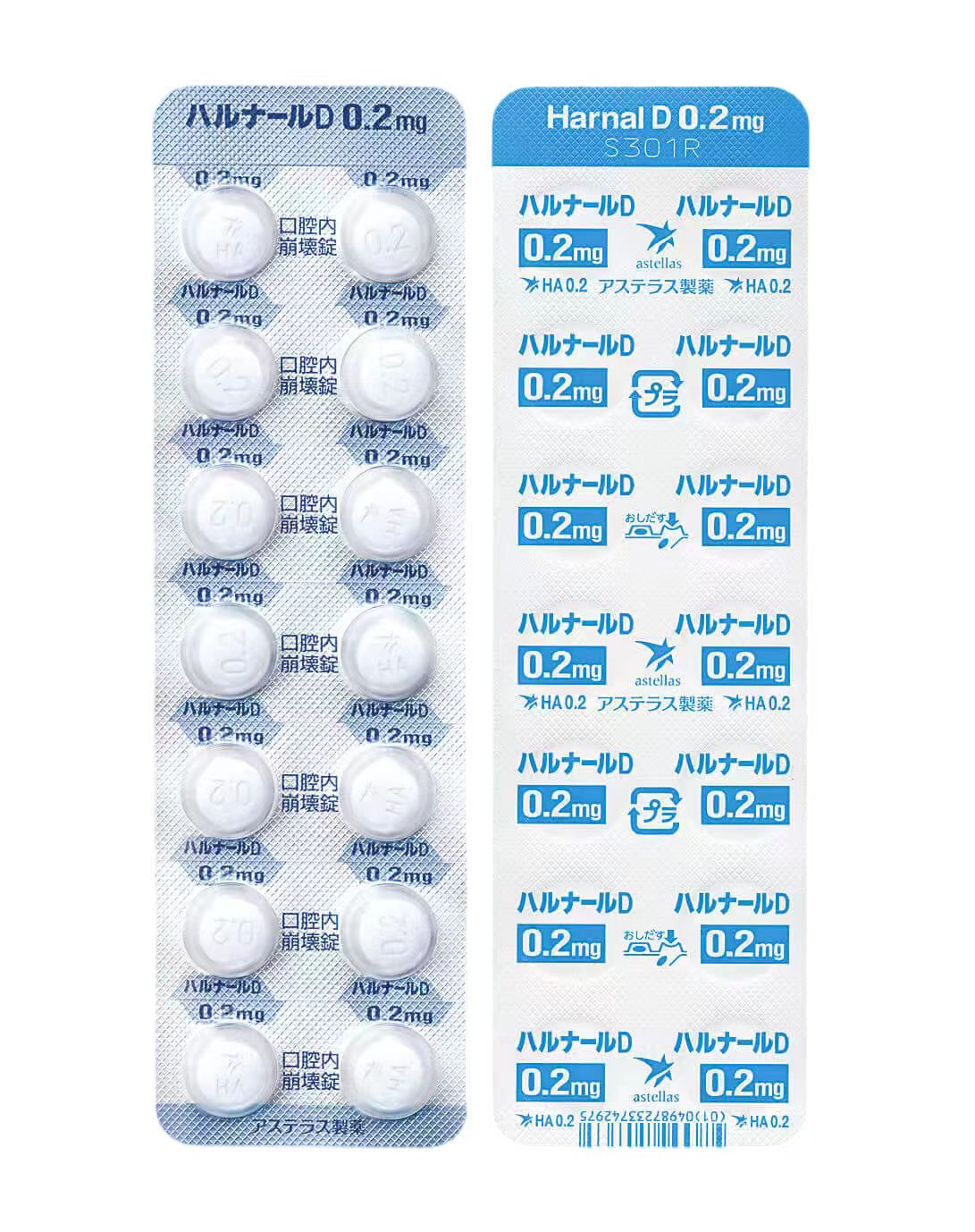
Harle-D (Tamsulosin) 0.2mg 140 tablets Harle-D tablets Tamsulosin Hydrochloride Astellas Prostate Urinary Disorders
Harle-D (Tamsulosin) 0.2mg 140 tablets Harle-D tablets Tamsulosin Hydrochloride Astellas Prostate Urinary Disorders
Regular price
¥10,500 JPY
Regular price
Sale price
¥10,500 JPY
Unit price
/
per
Couldn't load pickup availability
Tamsulosin reduces urethral pressure by blocking α1 receptors in the urethra and prostate, thus improving urinary disorders caused by benign prostatic hyperplasia (BPH). It is commonly used to treat urinary disorders caused by BPH.
I. Basic Drug Information
- Generic name : Tamsulosin Hydrochloride
- English name : Tamsulosin Hydrochloride
- Product Name : Haruna D Tablets (ハルナールD 錠)
- Dosage form : Intraorally disintegrating tablets
- Indications : Urinary obstruction associated with benign prostatic hyperplasia (BPH).
-
Element :
Specification Active ingredient (in 1 tablet) additive 0.1mg Tasloxine hydrochloride 0.1 mg (Japanese standard) Cellulose, hydroxypropyl methylcellulose, ethylcellulose, sodium carboxymethyl cellulose, magnesium stearate, povidone 80, sorbitol, ethyl acrylate, etc. 0.2mg Tasloxine hydrochloride 0.2 mg (Japanese standard) Calcium stearate, methylcellulose, polyoxyethylene stearate, D-mannitol, lactose hydrate, starch, magnesium stearate, etc. -
Characteristics :
- Dosage form: All are intraorally disintegrating tablets, white
- Appearance and dimensions:
Specification diameter thickness weight 0.1mg 7.5mm 3.3mm 0.12g 0.2mg 8.5mm 4.2mm 0.20g - Identification code: 0.1mg is "HA0.1", 0.2mg is "HA0.2"
II. Usage and Dosage
- Normally, the adult dosage is 0.2 mg of tasorlosine hydrochloride once a day, taken orally after a meal; the dosage may be adjusted according to age and symptoms.
- For elderly patients with impaired renal function: start with 0.1 mg, closely monitor the patient, and then increase to 0.2 mg; if 0.2 mg still does not achieve the expected effect, do not increase the dose further, and consider other appropriate treatments.
III. Taboos
This product is contraindicated in patients with a history of allergy to any of its ingredients.
IV. Precautions
-
Special populations :
- Patients with orthostatic hypotension: May experience worsening of symptoms, should exercise caution.
- Patients with severe renal impairment: Plasma drug concentrations may be elevated and monitoring is required.
- Patients with severe liver dysfunction: Plasma drug concentrations may be elevated and monitoring is required.
- Elderly individuals: may have impaired renal function and should start with a low dose.
-
Medication instructions :
- Avoid overdosing to prevent a drop in blood pressure.
- Postural changes in blood pressure (such as decreased blood pressure when standing) may occur, so attention should be paid to changing body positions.
- If you experience symptoms such as dizziness or vertigo, you should avoid engaging in dangerous activities such as working at heights or driving a car.
- Before administering medication, it is necessary to confirm whether you are currently using antihypertensive drugs; if you are, you need to closely monitor your blood pressure and reduce the dosage or stop the medication in time if your blood pressure drops.
- When administering the medication, instruct the patient to: remove the PTP from the packaging and take it (to avoid swallowing the packaging and causing esophageal damage); do not chew (may destroy the sustained-release particles and alter pharmacokinetics); it can be taken without water (it disintegrates after being moistened by saliva), but should not be taken without water while lying down.
-
Medication storage :
- Store at room temperature; shelf life is 3 years.
- PTP packaging should be kept dry after opening; bottled preparations contain desiccant and should be tightly capped and not left open.
V. Adverse Reactions
-
Allergic reaction :
- Common: Skin rash (incidence rate 0.1%~5%).
- Rare (frequency unknown): itching, urticaria, erythema multiforme, angioedema.
-
Digestive system reaction :
- Common symptoms (0.1%~5%) include: stomach discomfort, nausea, vomiting, heaviness in the stomach, stomach pain, loss of appetite, and difficulty swallowing.
- Rare (frequency unknown): thirst, constipation, diarrhea.
-
Other important adverse reactions :
- Major side effects (frequency unknown): absence of consciousness, loss of consciousness (due to decreased blood pressure); liver dysfunction, jaundice (with elevated AST/ALT).
- Neuropsychiatric symptoms: dizziness, vertigo (0.1%~5%); orthostatic dizziness, headache, drowsiness, etc. (frequency unknown).
- Circulatory system: palpitations (0.1%~5%); decreased blood pressure, orthostatic hypotension, arrhythmia (frequency unknown).
VI. Drug Interactions
- When used in combination with antihypertensive drugs: may increase the risk of orthostatic hypotension, and attention should be paid to dose reduction or blood pressure monitoring.
- When used in combination with phosphodiesterase type 5 inhibitors (such as sildenafil, vardenafil, etc.): it may enhance the vasodilatory effect, leading to symptomatic hypotension (the α-receptor blocking effect of this agent can enhance the antihypertensive effect of such drugs).
VII. Pharmacological effects
- Mechanism of action : It blocks α1 receptors in the urethra and prostate, reduces prostate pressure in the urethral pressure curve, and improves urinary disorders associated with benign prostatic hyperplasia.
- In vitro effects : In receptor binding experiments on human prostate specimens, the α1 receptor blocking effect was 2.2 times stronger than that of prazosin hydrochloride and 40 times stronger than that of phentolamine mesylate.
-
Animal function :
- It selectively blocks α1 receptors, and its blocking effect on α1 receptors in rat meninges and rabbit aortic arteries is 1/2.2 to 22 times stronger than that of prazosin and 45 to 140 times stronger than that of phentolamine; its selectivity for α1 receptors is 5400 to 24000 times that of α2 receptors.
- It has a 23-98 times stronger α1 receptor blocking effect on the smooth muscle of the urethra, prostate and bladder base in rabbits, and a 87-320 times stronger effect than prazolidine.
VIII. Pharmacokinetics
-
absorb :
- In healthy adults, after a single oral dose of 0.1–0.6 mg, the plasma concentration of the unchanging drug reaches its peak at 7–8 hours, with a half-life of 9.0–11.6 hours; Cmax (peak concentration) and AUC (area under the curve) are directly proportional to the dose.
- After 7 days of continuous administration, steady-state blood drug concentration was reached after 4 days, with a slightly prolonged half-life.
- Excretion : In healthy adults, after a single oral dose of 0.1–0.6 mg, the excretion rate in urine within 30 hours was 12%–14%; the excretion rate did not fluctuate significantly with continuous administration.
IX. Clinical Research
Domestic Phase II and III clinical trials show that:
- It can significantly reduce intraurethral pressure in the prostatic region and improve urine flow rate and residual urine volume in a dose-dependent manner.
- The percentages of “moderate improvement or better” at different doses were: 28.3% (15/53) with 0.1 mg once daily, 37.3% (62/166) with 0.2 mg once daily, and 38.6% (22/57) with 0.4 mg once daily.
10. Packaging Specifications
- 0.1mg: 140 tablets (14 tablets x 10 blisters, including desiccant).
- 0.2mg: 140 tablets (14 tablets x 10 blisters, including desiccant); 300 tablets (bottle, including desiccant); 560 tablets (14 tablets x 40 blisters, including desiccant).
XI. Production Information
Manufacturer : Astellas Pharmaceutical Co., Ltd.
Share