1
/
of
1
協和キリン株式会社
Regpara Cinacalcet Hydrochloride Tablets 25mg 100 tablets (Regpara Tablets) - Kyowa Thyroid
Regpara Cinacalcet Hydrochloride Tablets 25mg 100 tablets (Regpara Tablets) - Kyowa Thyroid
Regular price
¥59,000 JPY
Regular price
Sale price
¥59,000 JPY
Unit price
/
per
Couldn't load pickup availability
Cinacalcet hydrochloride tablets lower blood calcium by inhibiting the secretion of parathyroid hormone. They are indicated for hypercalcemia caused by secondary hyperparathyroidism or parathyroid carcinoma in patients undergoing dialysis for chronic kidney disease.
I. Basic Drug Information
- Generic name : Cinacalcet Hydrochloride
- English name : Cinacalcet Hydrochloride Tablets
- Product Name : Regpara Tablets, available in 12.5mg, 25mg, and 75mg strengths.
- Dosage form : Fructus tablets (film-coated tablets)
-
Indications
- Secondary hyperparathyroidism under maintenance dialysis
- Hypercalcemia caused by parathyroid carcinoma
- Hypercalcemia caused by primary hyperparathyroidism in patients who cannot undergo parathyroidectomy or whose condition has recurred after the procedure.
-
Element
Specification Active ingredients additive レグパラ tablets 12.5mg One tablet contains 13.78 mg of cinacalcet hydrochloride (equivalent to 12.5 mg of cinacalcet). Yellow ferric oxide, crospovidone, light anhydrous silica, crystalline cellulose, titanium dioxide, ferric oxide, magnesium stearate, talc, glyceryl triacetate, lactose hydrate, hydroxypropyl methylcellulose, partially pregelatinized starch, povidone, polyethylene glycol 400 レグパラ tablet 25mg One tablet contains 27.55 mg of cinacalcet hydrochloride (equivalent to 25 mg of cinacalcet). Cyan No. 2 aluminum lake, yellow ferric oxide, crospovidone, light anhydrous silica, crystalline cellulose, titanium dioxide, magnesium stearate, talc, triacetin, lactose hydrate, hydroxypropyl methylcellulose, partially pregelatinized starch, povidone, polyethylene glycol 400 レグパラ tablets 75mg One tablet contains 82.65 mg of cinacalcet hydrochloride (equivalent to 75 mg of cinacalcet). Yellow ferric oxide, crospovidone, crystalline cellulose, titanium dioxide, magnesium stearate, glyceryl triacetate, lactose hydrate, hydroxypropyl methylcellulose, partially pregelatinized starch, povidone, polyethylene glycol 400 -
Properties
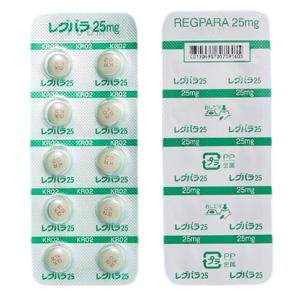
Specification color Dosage form Diameter (mm) Thickness (mm) Total weight (mg) Identification code レグパラ tablets 12.5mg pale yellow-red Film-coated tablets 6 3.4 Approximately 104 KR05 レグパラ tablet 25mg Pale green to pale yellowish green Film-coated tablets 8 4 Approximately 207 KR02 レグパラ tablets 75mg pale yellow Film-coated tablets 8 4 Approximately 207 KR03 - The active ingredient, cinacalcet hydrochloride, is a white to slightly yellowish-white crystalline powder, readily soluble in N,N-dimethylformamide, methanol, or ethanol (99.5%), sparingly soluble in water, and almost insoluble in ether. Its melting point is approximately 181°C. Its molecular formula is C(22H22F3Ncdot HCl) , and its molecular weight is 393.87.
II. Usage and Dosage
(a) Secondary hyperparathyroidism under maintenance dialysis
- Adult starting dose: 25 mg once daily (calculated as cinacalcet), orally.
- Dosage adjustment: The patient's parathyroid hormone (PTH) and serum calcium levels should be closely monitored, and the oral dose should be adjusted appropriately within the range of 25-75 mg once daily. If PTH does not improve, the upper limit of a single oral dose can be set at 100 mg.
- Incremental requirements: When increasing the dosage, each increment should be 25mg, and the interval between two increments should be more than 3 weeks.
(ii) Hypercalcemia caused by parathyroid carcinoma, hypercalcemia caused by primary hyperparathyroidism that is not suitable for parathyroidectomy or has recurred after surgery.
- Adult starting dose: 25 mg (calculated as cinacalcet) twice daily, orally.
- Dosage adjustment: The patient's serum calcium concentration should be closely monitored, and the dosage should be adjusted appropriately within the range of 25-75 mg per dose, twice daily. If serum calcium concentration does not improve, the single dose can be increased to 75 mg, up to a maximum of 3-4 times daily.
- Incremental requirements: When increasing the dosage, each increment should be 25mg, and the interval between two increments should be more than 2 weeks.
(III) Precautions regarding usage and dosage
- This drug has the effect of lowering blood calcium levels. Before starting administration, it is necessary to confirm that the serum calcium concentration is not low (the standard is above 9.0 mg/dL).
- Serum calcium concentration monitoring frequency: once a week at the start of administration and when adjusting the dose; at least once every 2 weeks during the maintenance period.
- Management of serum calcium levels:
serum calcium concentration Disposal measures Below 8.4 mg/dL In principle, the dosage of this drug should not be increased. If necessary, the dosage should be reduced, and calcium or vitamin D supplements may be considered. Serum calcium concentration should be measured at least once a week, and an electrocardiogram is recommended. If the dosage needs to be restarted or increased, it should only be done after confirming that the serum calcium concentration has recovered to above 8.4 mg/dL. Below 7.5 mg/dL Discontinue medication immediately; once serum calcium levels return to above 8.4 mg/dL, restart medication at the initial dose or a lower dose. - Recommendations for serum calcium concentration testing: To accurately determine the efficacy and safety of the medication, it is recommended to test serum calcium concentration before taking the medication. If hypoalbuminemia is present (serum albumin concentration below 4.0 g/dL), it is recommended to use the corrected serum calcium concentration as the indicator. The correction formula is: Corrected calcium concentration (mg/dL) = Serum calcium concentration.
- PTH monitoring: To maintain PTH within the target range, PTH needs to be measured regularly. Measure twice a month at the start of administration and during dose adjustments (standard is approximately 3 months after the start of administration); after confirming that PTH is substantially stable, measure once a month, and it is recommended to measure before starting medication.
III. Taboos
Patients with a history of allergy to any of the ingredients in this medicine are prohibited from using it.
IV. Precautions
(a) Special populations
- Patients with hepatic impairment : This drug is metabolized in the liver, and patients with hepatic impairment may have increased drug exposure, which requires special attention.
- Pregnant women and women who may be pregnant : It is recommended to avoid administration. In animal studies (rats and monkeys), hypocalcemia, inhibited weight gain, and reduced food intake were observed in the mothers, and the fetuses had lower weight. The drug can also cross the placenta.
- Breastfeeding women : The benefits of treatment and the nutritional benefits of breast milk should be considered when deciding whether to continue breastfeeding. In animal experiments (rats), it was found that the drug can be transferred into breast milk, and after administration to lactating mothers, newborn lactating rats experienced transient inhibition of weight gain.
- Children, etc .: Clinical trials with efficacy and safety indicators have not been conducted for children and other populations, and its use is not recommended.
- Elderly patients : The incidence of side effects (especially QT prolongation) is higher in patients over 65 years of age than in patients under 65 years of age. If side effects occur, measures such as dose reduction should be considered.
-
Patients with comorbid diseases/pre-existing medical history
- Patients with hypocalcemia: May worsen hypocalcemia.
- Patients with a history of or current seizures: There are reports of such patients experiencing seizures in overseas clinical trials.
- Patients with a history of gastrointestinal bleeding, peptic ulcers, or currently suffering from related diseases: may experience worsening or recurrence of symptoms.
(II) Medication Instructions
- Serum calcium concentration should be measured regularly during administration to closely monitor for hypocalcemia. If hypocalcemia occurs or is at risk, the dosage of this drug should be reduced, and calcium or vitamin D preparations may be given. If calcium or vitamin D preparations are discontinued during administration, precautions should be taken to prevent hypocalcemia.
- When starting medication and adjusting the dosage, patients' symptoms should be frequently observed, and attention should be paid to the occurrence of side effects.
- When delivering medication, patients should be instructed to remove the medication from the PTP blister pack before taking it to avoid accidentally swallowing the blister pack, as the hard, sharp edges of the blister pack may pierce the esophageal mucosa, even causing perforation and leading to serious complications such as mediastinitis.
- This drug is not approved for use in patients with chronic renal insufficiency who have secondary hyperparathyroidism prior to dialysis initiation and is not recommended for use.
- Overseas reports indicate that this drug may cause non-bone formation due to excessive reduction of PTH, or cause hunger bone syndrome with hypocalcemia and hypophosphatemia due to a sharp decrease in PTH after administration, which requires special attention.
(III) Drug Preservation
- Storage method: Store at room temperature
- Validity period: 3 years
V. Adverse Reactions
(a) Allergic reaction
While no specific allergic reaction is explicitly mentioned, this medication is contraindicated for those allergic to any of its ingredients. If symptoms such as rash or itching appear during use, or if suspected allergic reactions occur, discontinue use immediately and seek medical attention.
(ii) Digestive system reactions
The main adverse reaction categories are as follows:
| Incidence | symptom |
|---|---|
| 5% or more | Nausea and vomiting (25.1%), stomach discomfort (17.1%), loss of appetite, abdominal distension. |
| 1%~5% | Upper abdominal pain, diarrhea, constipation, gastritis and duodenitis, indigestion, abdominal discomfort, gastrointestinal disorders, reflux esophagitis, abdominal pain |
| Below 1% | Stomach ulcers, stomatitis, epigastric discomfort, occult blood in stool, gastroenteritis, hemorrhoids, hiatal hernia |
(iii) Other significant adverse reactions
- Hypocalcemia and decreased serum calcium (13.7%) : May be accompanied by symptoms such as QT prolongation, numbness, muscle cramps, mood disturbances, arrhythmias, hypotension, and spasms. Serum calcium concentration should be checked immediately, and calcium or vitamin D supplements should be administered if necessary. Overseas clinical trials have shown that patients with renal insufficiency are more likely to experience serum calcium concentrations below the lower limit of normal (8.4 mg/dL) after administration compared to dialysis patients.
- QT prolongation (5.3%) : may be related to hypocalcemia, and ECG and serum calcium concentration need to be monitored.
- Gastrointestinal bleeding, gastrointestinal ulcers (incidence unknown) : Patients need to be closely monitored for symptoms such as melena and hematemesis. If these occur, medication should be stopped immediately and treatment initiated.
- Decreased level of consciousness (0.2%), transient loss of consciousness (0.2%) : It is necessary to pay attention to the patient's level of consciousness and deal with any abnormalities in a timely manner.
- Sudden death (0.3%) : There are reports of sudden deaths with no known cause, which warrants vigilance.
-
Other systemic adverse reactions
system Incidence symptom Circulator 1%~5% High blood pressure, arrhythmia Circulator Below 1% Low blood pressure, myocardial infarction, premature ventricular contractions, atrial fibrillation, palpitations, myocardial ischemia, premature upper ventricular contractions, tachycardia Psychosomatic 1%~5% Headache, numbness, dizziness, illusions, insomnia Jingu grid 1%~5% Muscle spasms, limb pain, joint pain Jingu grid Below 1% Muscle pain, stiffness metabolism Below 1% Elevated creatine kinase (CK), elevated lactate dehydrogenase (LDH), elevated blood glucose, dehydration, hyperlipidemia, and elevated total cholesterol. Sensory organs 1%~5% taste abnormality liver 1%~5% Elevated alkaline phosphatase (Al-P) liver Below 1% Elevated levels of aspartate aminotransferase (AST), alanine aminotransferase (ALT), bilirubin, and gamma-glutamyl transferase (γ-GTP). Eye Below 1% Conjunctival hemorrhage, dry eyes skin 1%~5% itching skin Below 1% Rash, hair loss, subcutaneous bleeding endocrine Below 1% goiter blood 1%~5% anemia blood Below 1% Thrombocytopenia other 1%~5% fatigue, edema other Below 1% Symptoms include: poor mood, fatigue, chest discomfort, thirst, weight loss, bowel obstruction, chest pain, fever, and erectile dysfunction.
VI. Drug Interactions
| Drug categories | Examples of drugs | Interaction results | Mechanism/Risk Factors |
|---|---|---|---|
| Azole antifungals, macrolide antibiotics, itraconazole, etc. | Erythromycin, amoroxin hydrochloride, clarithromycin, etc. | This may lead to an increase in the blood concentration of the drug and enhance its effects. | The metabolism of this drug is mainly related to CYP3A4. These drugs are CYP3A4 inhibitors; concomitant use will inhibit the metabolism of this drug and increase its blood concentration. For example, when this drug is used in combination with ketoconazole, the area under the concentration-time curve (AUC) of this drug increases approximately twofold. |
| Tricyclic antidepressants | Amitriptyline hydrochloride, imipramine hydrochloride, etc. | This may lead to increased blood concentrations of such drugs. | This drug has CYP2D6 inhibitory activity, which can inhibit the metabolism of CYP2D6 substrate drugs and increase their blood concentration; when this drug is used in combination with dextromethorphan hydrobromide, the AUC of dextromethorphan hydrobromide increases by approximately 11 times. |
| Butyrophenone antipsychotics | Haloperidol acetate, benpiridol sulfate, haloperidol, etc. | This may lead to increased blood concentrations of such drugs. | This drug has CYP2D6 inhibitory activity, which can inhibit the metabolism of CYP2D6 substrate drugs and increase their blood drug concentration. |
| Calcium absorption inhibitors | pamidronate disodium hydrate, alendronate sodium hydrate, etc. | May lead to decreased serum calcium concentration | Enhance the effect of this drug in lowering blood calcium levels |
| Adrenocortical hormones | Beclomethasone dipropionate, etc. | May affect the blood concentration of this drug | Because adrenocortical hormones have a high plasma protein binding rate, they may compete with this drug for plasma protein binding sites. |
| Digoxin, diazepam, etc. | Digoxin, diazepam | There may be interaction risks. | [Reference 16.3] |
| Drugs that alter the pH of the stomach (such as calcium carbonate) and phosphorus adsorbents (such as sevelamer hydrochloride) | Calcium carbonate, sevelamer hydrochloride | It has no significant effect on the pharmacokinetics of this drug. | Combined drug trials have confirmed that these drugs do not alter the pharmacokinetic characteristics of this drug. |
VII. Pharmacological effects
This drug is a calcium receptor agonist, exerting its effects by acting on calcium receptors on the surface of parathyroid cells. Its specific mechanisms of action are as follows:
- Regulation of parathyroid hormone (PTH) related functions : Calcium receptors can regulate PTH secretion, PTH biosynthesis and parathyroid cell proliferation. After this drug stimulates calcium receptors, it mainly reduces serum PTH concentration by inhibiting PTH secretion; with repeated administration, its inhibitory effect on parathyroid cell proliferation also helps to reduce serum PTH concentration.
- Inhibition of PTH secretion (in vitro experiment) : This drug can inhibit the secretion of PTH by rat parathyroid cells and human parathyroid cells in a concentration-dependent manner.
- Inhibition of parathyroid cell proliferation : Repeated oral administration to partially nephrectomized rats showed that this drug could inhibit parathyroid cell proliferation and delay the progression of parathyroid hyperplasia.
- Decreasing serum PTH and calcium concentrations : In normal rats and partially nephrectomized rats, a single oral administration of this drug can dose-dependently decrease serum PTH and calcium concentrations.
- Inhibition of bone damage : In secondary hyperparathyroidism, elevated serum PTH concentration can induce bone damage; repeated oral administration to partially nephrectomized rats can inhibit bone damage symptoms such as myelofibrosis, cortical osteoporosis, decreased cortical bone mineral density and decreased bone strength caused by elevated serum PTH concentration.
VIII. Pharmacokinetics
(a) Absorption
- Bioavailability: When this drug (25~100mg) is administered orally, the bioavailability (average) is 5.1~28.4% in China and 7.9~24.4% overseas.
- Food effects: In healthy adults, the pharmacokinetic parameters of a single oral dose of 50 mg of this drug are basically the same whether administered on an empty stomach or after a meal, indicating that food has little effect on the pharmacokinetics of this drug.
- Time to peak plasma concentration (tmax):
- In healthy adults, the tmax was 3.9±1.4h, 4.0±0.0h, and 4.0±1.3h for single oral doses of 25mg, 50mg, and 100mg, respectively.
- For hemodialysis patients: when taking 25mg, 50mg, and 100mg orally in a single dose, the tmax on non-dialysis days was 5.6±1.1h, 6.0±1.1h, and 4.8±1.8h, respectively; and the tmax on dialysis days was 4.8±1.4h, 4.6±1.6h, and 4.4±1.8h, respectively.
(II) Distribution
- Plasma protein binding rate: In in vitro experiments on healthy adults, the plasma protein binding rate of cinacalcet (25~100 ng/mL) was 96.67~97.67% for men and 94.33~97.67% for women, with no significant difference between the sexes; the plasma protein binding rates in foreign individuals with normal liver and kidney function and those with liver and kidney dysfunction were 94.7~97.1% and 92.7~95.1%, respectively, which were similar to those in healthy adults.
- Binding protein: It mainly binds to albumin and has a high affinity for albumin region II.
(III) Metabolism
In healthy foreign adults, cinacalcet is rapidly metabolized via N-dealkylation or naphthalene epoxidation after a single oral dose of 75 mg of the 14C-labeled drug.
(iv) Excretion
- Excretion route: Mainly excreted in urine as metabolic products.
- Urinary excretion rate: In healthy adults, the unchanged drug is excreted in urine at a very low rate, and repeated administration has no significant effect on urinary excretion.
- Elimination half-life (t1/2):
- In healthy adults, the half-life (t1/2) for single oral doses of 25 mg, 50 mg, and 100 mg were 7.70 ± 3.54 h, 24.81 ± 9.41 h, and 32.22 ± 5.63 h, respectively.
- For hemodialysis patients: when taking 25mg, 50mg, and 100mg orally once, the half-life (t1/2) on non-dialysis days was 28.45±14.24h, 38.58±20.19h, and 38.47±8.62h, respectively; and the half-life (t1/2) on dialysis days was 32.94±14.52h, 33.96±10.23h, and 40.12±7.50h, respectively. Dialysis had no significant effect on the elimination of this drug.
(v) Pharmacokinetics in Special Populations
Patients with liver dysfunction: Compared with healthy adults, patients with liver dysfunction who took 50 mg of this drug orally on an empty stomach after a single dose showed that the AUC of moderate and severe liver dysfunction according to the Child-Pugh classification was 2.4 times and 4.2 times higher, respectively, than that of patients with normal liver function; the AUC of patients with mild liver dysfunction was similar to that of patients with normal liver function.
(vi) Pharmacokinetics of repeated administration
- For healthy adults: Take 50 mg of this drug orally daily for 7 consecutive days, during which time the blood drug concentration will basically reach a steady state.
- For hemodialysis patients: after repeated administration and observation for up to 53 weeks, the blood drug concentration did not show a significant time-dependent increase or decrease and could reach a steady state.
IX. Clinical Research
(a) Secondary hyperparathyroidism under maintenance dialysis
1. Domestic Phase II/III trials (hemodialysis)
- Subjects: 369 patients with secondary hyperparathyroidism during hemodialysis.
- Dosage regimen: Start with 25 mg once daily, which can be adjusted to 100 mg, for 52 weeks orally.
- Trial results: At the end of the treatment, the proportion of patients whose serum intrinsic PTH concentration reached the target value (below 250 pg/mL) was 43.8%.
2. Domestic Phase III trial (hemodialysis)
- Subjects: 143 patients with secondary hyperparathyroidism during hemodialysis were divided into the drug group (72 cases) and the placebo group (71 cases).
- Dosage regimen: Both groups started with 25 mg once daily, with the dose adjustable to 100 mg, for 14 weeks orally.
- Results: At the end of the treatment, the proportion of patients whose serum intrinsic PTH concentration reached the target value (below 250 pg/mL) was 51.4% in the drug group and 2.8% in the placebo group, which was significantly higher in the drug group ( chi^2=42.521 , p<0.001) . The incidence of side effects in the drug group was 73.6% (53/72 cases), with the main side effects being nausea (33.3%), stomach discomfort (22.2%), vomiting (19.4%), fatigue (9.7%), and indigestion (8.3%).
3. Other domestic hemodialysis-related trials
- 105 patients: The medication was started at 25 mg once daily, and the dose could be adjusted to 100 mg orally; the incidence of side effects was 84.8% (89/105 patients), and the main side effects were nausea and vomiting (22.9%), hypocalcemia (21.9%), vomiting (15.2%), prolonged QT interval on electrocardiogram (13.3%), and loss of appetite (11.4%).
- 65 patients: The medication was started at 12.5 mg once daily, and the dose could be adjusted to 100 mg, and the oral administration was continued for 44 weeks. At the end of the administration, the proportion of patients whose serum intrinsic PTH concentration reached the target value (below 250 pg/mL) was 43.1%. The incidence of side effects was 70.8% (46/65 patients), and the main side effects were nausea (18.5%), abdominal distension (16.9%), stomach discomfort (13.8%), loss of appetite (12.3%), upper abdominal pain, digestive discomfort, vomiting, and decreased appetite (7.7% each).
- 199 patients: The medication was started at 25 mg once daily, and the dose could be adjusted to 100 mg, and the oral administration was continued for 52 weeks; at the end of the administration, the proportion of patients whose serum intrinsic PTH concentration reached the target value (below 250 pg/mL) was 57.8%; the incidence of side effects was 72.5% (145/200 patients), and the main side effects were gastrointestinal discomfort (21.5%), nausea (14%), vomiting (9.5%), hypocalcemia (9.0%), and loss of appetite (7.5%).
4. Domestic Phase III trial (peritoneal dialysis)
- Subjects: 29 patients with secondary hyperparathyroidism during peritoneal dialysis.
- Dosage regimen: Start with 25 mg once daily, which can be adjusted to 100 mg, for 16 weeks orally.
- Results: At the end of the treatment, 24.1% of patients achieved the target serum intrinsic PTH concentration (below 250 pg/mL), confirming that the drug has the effect of reducing serum intrinsic PTH concentration in peritoneal dialysis patients. The incidence of side effects was 75.9% (22/29 cases), with the main side effects being nausea (41.4%), vomiting, stomach discomfort (20.7% each), loss of appetite (17.2%), abdominal distension, decreased serum calcium, decreased blood pressure, and hypocalcemia (6.9% each).
(ii) Hypercalcemia caused by parathyroid carcinoma, hypercalcemia caused by primary hyperparathyroidism in which parathyroidectomy is not possible or recurrence occurs after surgery.
1. Domestic Phase III Trial
- Subjects: 7 patients, including 5 with parathyroid carcinoma and hypercalcemia, and 2 with primary hyperparathyroidism and hypercalcemia who were unable to undergo parathyroidectomy or had recurrence after surgery.
- Dosage regimen: Start with 25 mg twice daily, and the dose can be adjusted to 75 mg three times daily, orally, for a period of 4 to 13 weeks.
- Trial results: At the end of the dose adjustment period, 5 out of 7 patients had a corrected serum calcium concentration that decreased by more than 1.0 mg/dL from baseline, and 5 of them decreased to below 10.3 mg/dL; the incidence of side effects was 100% (7/7), and the main side effects were nausea (57.1%), vomiting (42.9%), gastroesophageal reflux disease (28.6%), constipation, gastritis, oral discomfort, liver dysfunction, decreased serum zinc, increased low specific gravity lipoprotein, weight loss, muscle cramps, headache, and sensory dullness (14.3% each).
2. Overseas Phase II Trials
- Subjects: 46 patients, including 29 patients with parathyroid carcinoma and 17 patients with primary hyperparathyroidism who were contraindicated for parathyroidectomy or had recurrence after surgery and whose serum calcium concentration exceeded 12.5 mg/dL.
- Dosage regimen: Start with 30 mg twice daily, and the dose can be adjusted to 90 mg four times daily, orally, for a period of 1 to 22 weeks.
- Trial results: At the end of the dose adjustment period, serum calcium concentration decreased by more than 1.0 mg/dL in 33 of the 46 patients (71.7%), and decreased to less than 10.3 mg/dL in 14 patients (30.4%). The incidence of side effects was 84.8% (39/46 patients), and the main side effects were nausea (58.7%), vomiting (41.3%), illusion (15.2%), weight loss, loss of appetite (8.7% each), asthenia, dehydration, muscle cramps, and headache (6.5% each).
10. Packaging Specifications
| Drug specifications | Packaging |
|---|---|
| レグパラ tablets 12.5mg | [PTP] 100 tablets (10 tablets x 10 blisters) |
| レグパラ tablet 25mg | [PTP] 100 tablets (10 tablets x 10 blisters) |
| レグパラ tablets 75mg | [PTP] 100 tablets (10 tablets x 10 blisters) |
XI. Production Information
- Manufacturer : Kyowa Kirin Co., Ltd.
Share