1
/
of
1
ミヤリサン製薬株式会社
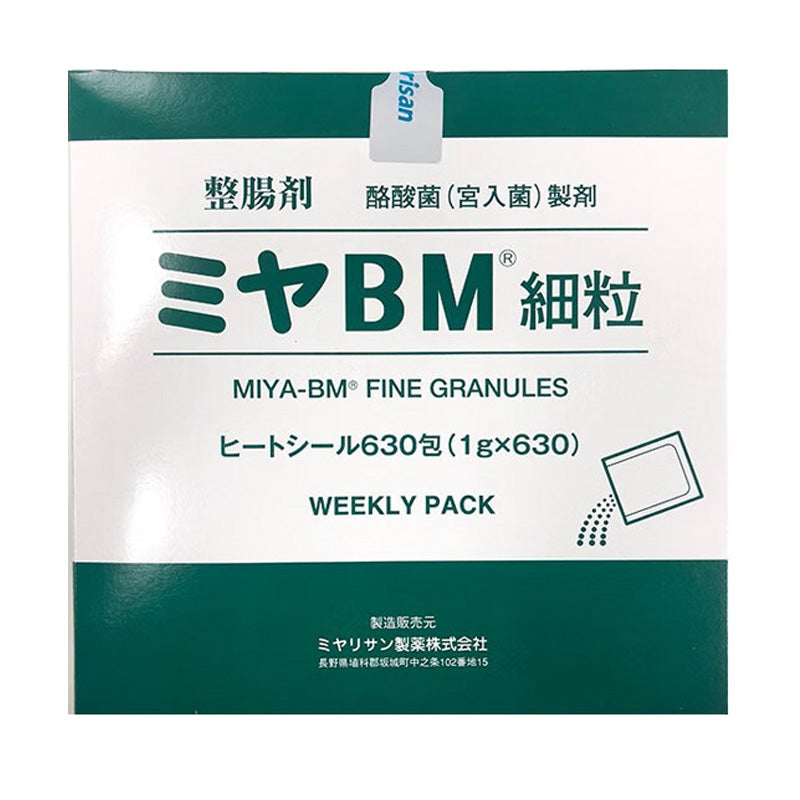
MIYA-BM Butyric Acid Bacteria (Miyari Bacteria) Fine Granules: 1g x 630 packets MIYA-BM Fine Granules Probiotics
MIYA-BM Butyric Acid Bacteria (Miyari Bacteria) Fine Granules: 1g x 630 packets MIYA-BM Fine Granules Probiotics
Regular price
¥9,900 JPY
Regular price
Sale price
¥9,900 JPY
Unit price
/
per
Taxes included.
Couldn't load pickup availability
MiyaBM is used to improve various symptoms caused by abnormal gut microbiota.
I. Basic Drug Information
- Common name : Butyric acid bacteria (uterine bacteria) preparation
- English name : MIYA-BM FINE GRANULES (ミヤBM fine particles), MIYA-BM TABLETS (ミヤBM ingots)
- Product name : MINIBM fine granules, MINIBM tablets
- Dosage forms : granules, tablets
- Indications : To improve various symptoms caused by abnormal gut microbiota.
-
Element
- Active ingredients : Each 1g of MiyaBM fine granules contains 40mg of cypermethrin powder; each 1 tablet of MiyaBM tablets contains 20mg of cypermethrin powder.
- Additives : Mito BM fine granular lactose-containing water mixture, Tomo ロコシデンプン, precipitated calcium carbonate, sugar, Mito BM The tablet contains lactose hydrate, precipitated calcium carbonate, sugar, and タルク.
- Appearance : MiyaBM fine granules are white to light grayish-white fine granules; MiyaBM tablets are white to light grayish-white tablets, 9 mm in diameter and 4.2 mm thick, with a package weight of 350 mg.
II. Usage and Dosage
- Fine granules : The usual adult dosage is 1.5-3g daily, divided into 3 oral doses. The dosage may be adjusted according to age and symptoms.
- Tablets : The usual adult dosage is 3-6 tablets daily, divided into 3 oral doses. The dosage may be adjusted according to age and symptoms.
III. Taboos
No explicitly prohibited content was mentioned.
IV. Precautions
- Special populations : No special precautions are mentioned for special populations (such as pregnant women, breastfeeding women, children, the elderly, and those with liver or kidney dysfunction).
-
Medication guidance
- When preparing medicines, mixing MiyaBM granules and MiyaBM tablets with Aminofirin and Isoniad may cause discoloration; it is recommended to avoid mixing them.
- When delivering tablets, patients should be instructed to remove the medication from the PTP liner before taking it. Swallowing the PTP liner can cause serious complications, such as mediastinitis, as its sharp, hard edges may pierce the esophageal mucosa.
- Drug storage : Store at room temperature. Once opened, seal tightly and store in a low-humidity environment. Shelf life is 3 years.
V. Adverse Reactions
No specific adverse reactions were mentioned.
VI. Drug Interactions
No specific details regarding drug interactions were mentioned.
VII. Pharmacological effects
- Adjusting biomembrane function : No relevant content was mentioned.
- Improve metabolic abnormalities : Uterine bacteria can produce amylase and B vitamins (B1, B2, B12, niacin, folic acid), which help improve the body's metabolism.
- Regulating blood lipids : No relevant information was mentioned.
- Protecting blood vessels : No relevant information was mentioned.
-
Other functions
- Intestinal bacteria germinate and proliferate in the intestine, producing short-chain fatty acids such as butyric acid and various metabolites. They inhibit the growth of harmful and pathogenic bacteria, promote the development of beneficial bacteria, regulate the balance of intestinal flora, and improve symptoms caused by abnormal intestinal flora.
- Butyric acid can promote the proliferation of digestive tract mucosal epithelial cells, regulate water and electrolyte absorption, and is an important energy source for colonic epithelial cells.
- The culture filtrate of *Bacteroides galbana* can antagonize intestinal smooth muscle contractions caused by enterotoxins (such as ceratonin) and alleviate symptoms related to abnormal intestinal contractions.
- When using chemotherapy agents (antimicrobial agents), Urinary bacteria can reduce the detection rate and number of pseudomembranous colitis pathogens (such as Clostridium difficile) in feces, thereby reducing the risk of antimicrobial agent-associated intestinal flora imbalance; in germ-free mice infected with Clostridium difficile, it can reduce mortality and alleviate intestinal epithelial cell necrosis and hemorrhage.
- In elderly patients undergoing managemental nutrition therapy, uterine bacteria can inhibit intestinal mucosal atrophy, reduce fecal water content, and improve fecal characteristics and defecation frequency. In rats given component nutrients, it can increase the proliferation rate of goblet cells in the digestive tract of the jejunum, ileum, cecum, and distal colon.
- In the rat DSS colitis model, *Bacteroides uteri* increased the content of short-chain fatty acids such as butyric acid in the intestine, reduced the ulcer index and myeloperoxidase (MPO) activity, and alleviated intestinal inflammation.
VIII. Pharmacokinetics
- Absorption : No relevant content was mentioned.
- Distribution : When rats were orally administered 10^7 cytomegalovirus bacteria, the bacteria germinated in the upper to middle part of the small intestine 30 minutes later, began to divide and proliferate in the lower part of the small intestine 2 hours later, and were widely distributed from the stomach to the large intestine 5 hours later.
- Excretion : In healthy adult males, after administration of 10^7 units of Urethrium, Urethrium can be detected in feces within 1 to 2 days, and disappears in feces after 3 to 5 days; In rats, after oral administration, Urethrium is excreted in feces within 3 days.
IX. Clinical Research
- Clinical studies on the use of probiotic preparations showed that the improvement rate for gastroenteritis was 75% (3/4 cases); for abdominal symptoms, the improvement rate for diarrhea was 80% (271/338 cases), the improvement rate for constipation was 67% (6/9 cases), the improvement rate for alternating bowel abnormalities was 80% (8/10 cases), and the improvement rate for soft stools was 59% (94/159 cases).
- Among infants, toddlers, and young children who used antibiotics for acute nasopharyngitis or acute tonsillitis, 19 out of 40 children (47.5%) who used antibiotics alone developed diarrhea, while only 17 out of 91 children (18.7%) who used probiotics in combination developed diarrhea, indicating that probiotics can reduce the incidence of antibiotic-associated diarrhea.
- In a study of 47 children with Clostridium difficile enteritis, the combination of uterine probiotics, antibiotics, and antidiarrheal agents, or a combination of two or three drugs, showed that the children treated with a combination of uterine probiotics and antibiotics recovered the fastest.
10. Packaging Specifications
- Fine granules : in bags, available in 500g, 1kg (500g×2), and 5kg (500g×10); HS packaging, available in 1g×630 bags and 1g×2520 bags.
- Tablets : 1000 tablets per bag; PTP packaging available in 100 tablets (10 tablets x 10 pieces), 400 tablets (10 tablets x 10 pieces x 4), and 800 tablets (10 tablets x 10 pieces x 8).
XI. Production Information
- Manufacturer : Militron Manufacturing Co., Ltd.
Share