1
/
/
1
バイエル薬品株式会社
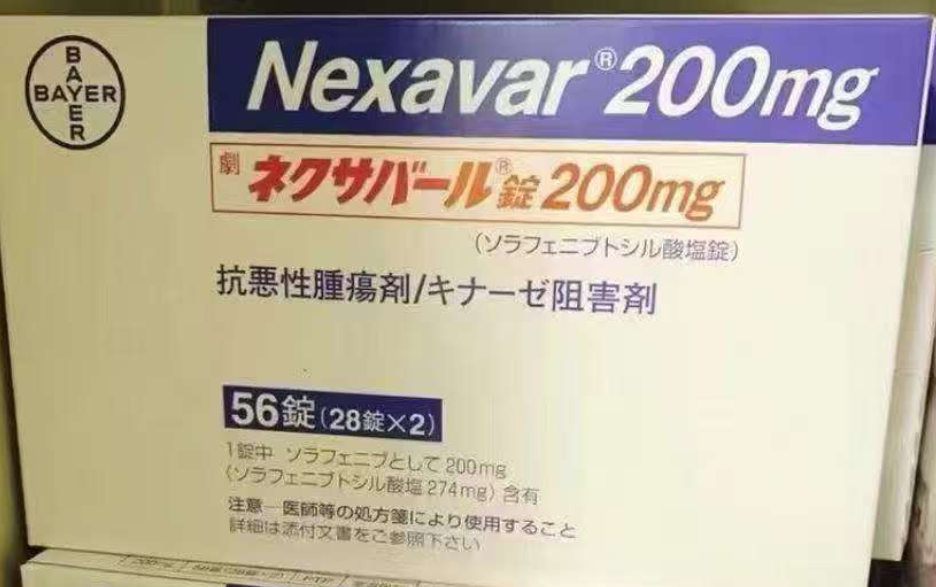
Sorafenib Tosilate 200mg (56 tablets) - Bayer anticancer and antitumor drug.
Sorafenib Tosilate 200mg (56 tablets) - Bayer anticancer and antitumor drug.
定價
¥330,000 JPY
定價
售價
¥330,000 JPY
單價
/
每
已包含稅額。
無法載入取貨服務供應情況
Sorafenib is a multi-target tyrosine kinase inhibitor, primarily used for the treatment of malignant tumors.
I. Basic Drug Information
- Generic Name : Sorafenib Tosylate Tablets
- English name : Sorafenib Tosilate Tablets
- Product name : Nexavar tablets 200mg (Nexavar tablets 200mg)
- Dosage form : Film-coated tablets
-
Indications :
- Radical resection of unresectable or metastatic renal cell carcinoma
- Unresectable hepatocellular carcinoma
- Radical cure of thyroid cancer that cannot be removed
-
Element :
- Active ingredient : Each tablet contains 200mg of sorafenib (274.0mg as sorafenib tosylate).
- Additives : croscarmellose sodium cellulose, crystalline cellulose, hydroxypropyl methylcellulose, sodium lauryl sulfate, magnesium stearate, polyethylene glycol 4000, titanium dioxide, ferric oxide
-
Characteristics :
- Color tone: Red
- Diameter: 10mm
- Thickness: 4.5mm
- Weight: 349.85mg
- Identification code: 200
II. Usage and Dosage
-
The usual dosage for adults is 400 mg (calculated as sorafenib) twice daily orally, which may be adjusted according to the patient's condition.
-
Dosage adjustment plan
- Radical cure of unresectable or metastatic renal cell carcinoma and unresectable hepatocellular carcinoma
| Dosage adjustment phase | Dosage |
|---|---|
| Standard dose | 400mg/dose, twice daily orally |
| Level 1 reduction | 400mg once daily orally |
| Level 2 reduction | 400mg/dose, orally every other day |
- Radical cure of thyroid cancer that cannot be removed
| Dosage adjustment phase | Dosage |
|---|---|
| Standard dose | 400mg/dose, twice daily orally |
| Level 1 reduction | 400mg and 200mg alternated orally every 12 hours. |
| Level 2 reduction | 200mg/dose, twice daily orally |
| Level 3 reduction | 200mg once daily orally |
-
Usage-related precautions
- The efficacy and safety of combining sirolimus with other anti-cancer drugs containing sirolimus have not been established.
- A high-fat diet can lower blood drug concentrations, so medication should be avoided between 1 hour before and 2 hours after meals.
- When dosage adjustments are necessary due to side effects, specific standards must be followed according to the toxicity classification (dermal toxicity, hematological toxicity, non-hematological toxicity) (see "Precautions" for details).
III. Taboos
- Those with a history of severe allergies to any of the ingredients in this medicine.
- Pregnant women or women who may become pregnant (animal studies have shown embryotoxicity and teratogenicity).
IV. Precautions
-
Precautions for medication use in special populations
- For patients with hypertension : This may worsen hypertension, so blood pressure needs to be monitored regularly, and medication may need to be discontinued if necessary.
- Patients with liver dysfunction : Contraindicated in patients with severe liver dysfunction (Child-Pugh C) (excluded from clinical trials).
- Breastfeeding women : It is recommended to stop breastfeeding during the period of discontinuation of medication (the medication can enter breast milk).
- Children : No clinical trials have been conducted, but animal studies have shown effects on bones and teeth.
- Elderly individuals : Due to decreased physiological function, medication should be administered with caution and close monitoring is necessary.
-
Medication monitoring and management
- It should be used under the guidance of a physician with experience in cancer chemotherapy in a medical facility capable of handling emergencies.
- Before treatment, the risks and benefits should be fully explained to the patient and their family, and medication should be administered only after obtaining their consent.
- Regular check-up items include: liver function, complete blood count (including white blood cell differential), pancreatic enzymes, serum electrolytes, kidney function, and blood pressure.
- Severe skin reactions may occur (such as hand-foot syndrome, toxic epidermal necrolysis), requiring prompt dermatological consultation.
- It may cause acute lung injury and interstitial pneumonia, and symptoms such as difficulty breathing and fever need to be monitored.
- Medication should be suspended during surgery (which may delay wound healing), and the patient's condition should be assessed before resuming medication after surgery.
-
Drug Preservation
- Storage: Store at room temperature
- Validity period: 36 months
- Once opened, the aluminum bag should be stored in a moisture-proof environment (to avoid reducing its leaching properties).
V. Adverse Reactions
-
Serious adverse reactions (requiring immediate treatment)
- Skin: Hand-foot syndrome (46.7%), exfoliative dermatitis, toxic epidermal necrolysis (TEN), etc.
- Digestive diseases: gastrointestinal bleeding (7.5%), gastrointestinal perforation (potentially fatal), pancreatitis (0.3%).
- Blood: Leukopenia (1.5%), thrombocytopenia (2.1%), anemia (3.4%).
- Other: acute lung injury, hypertensive crisis, tumor lysis syndrome, liver failure, etc.
-
Common adverse reactions
- Digestive system: diarrhea, nausea, loss of appetite (occurrence rate over 10%).
- Skin: hair loss, rash, itching (occurrence rate over 10%).
- Systemic symptoms: fatigue, weight loss (occurrence rate over 10%).
-
Adverse reaction management
- Mild reactions (such as Grade 1 skin toxicity) can be treated with continued medication and symptomatic treatment.
- For moderate to severe reactions (such as grade 3 hematologic toxicity), the medication should be discontinued until symptoms subside, and then the dosage should be gradually reduced before resuming administration.
- Life-threatening reactions (such as grade 4 non-hematologic toxicity) require permanent discontinuation of the drug.
VI. Drug Interactions
| Combination drugs | Interaction influence | Precautions |
|---|---|---|
| Irinotecan | Elevated AUC of irinotecan and its metabolite SN-38 | Toxicity reactions need to be monitored. |
| warfarin | Increased risk of bleeding, prolonged INR | Regularly monitor coagulation function |
| CYP3A4 inducers (such as rifampin) | The blood concentration of this drug is reduced. | Avoid combined use or adjust dosage |
| Fluconazole | This drug reduces AUC by 54%. | The efficacy needs to be evaluated, and the dosage adjusted if necessary. |
VII. Pharmacological effects
- Mechanism of action : It inhibits tumor cell proliferation-related C-Raf and B-Raf kinases, as well as tumor angiogenesis-related VEGF receptors and PDGF receptors, thereby inhibiting tumor growth and angiogenesis.
- Anti-tumor effect : It can inhibit tumor proliferation in animal models such as renal cell carcinoma and hepatocellular carcinoma.
VIII. Pharmacokinetics
- Absorption : Peak plasma concentration (Cmax) is reached 8 hours after oral administration. Absorption is reduced by a high-fat diet (AUC decreases by 29%).
- Distribution : 99.5% of plasma proteins are bound, mainly to albumin.
- Metabolism : Metabolized by CYP3A4 and UGT1A9, with metabolites accounting for 6-12% of the total AUC.
- Excretion : 77% is excreted in feces within 14 days, and 19% is excreted in urine.
IX. Clinical Research
- Renal cell carcinoma : Phase III trials showed a significant increase in progression-free survival (PFS) compared to placebo (168 days vs 84 days, p<0.000001).
- Hepatocellular carcinoma : Phase III trials showed a significant increase in overall survival (OS) (324 days vs 241 days, p=0.000583).
- Thyroid cancer : Phase III trials showed significantly prolonged progression-free survival (PFS) (329 days vs 175 days, p<0.0001).
10. Packaging Specifications
56 tablets/box (28 PTP tablets x 2)
XI. Production Information
Manufacturer : バイエル薬品 Co., Ltd.
Share